Last summer, Bruce Booth and I wrote a paper in Nature Biotech examining the returns differences between healthcare and IT investments over the past decade.
What came as a surprise to many in the industry, including many LPs I have spoken to, was that healthcare venture investments have produced better realized returns for LPs over the past decade than IT investments have.
Let me say that again for those of you who didn’t see the paper: Healthcare investments outperformed IT investments over the past decade.
But the news wasn’t all good. In the accompanying blog post, Bruce and I touched on the fact that the data showed that the unrealized portfolio of active investments across all of healthcare venture is basically being carried at no mark-up whatsoever vs. a nice mark-up for IT investments that are still unrealized.
In that post, we explained the following:
As we outline in our paper, significant mark-ups from round to round tend not to occur in LS companies. Instead, even well performing LS companies tend to be held at or near cost until an exit occurs leading to punitively low unrealized LS IRRs. Tech companies that perform well, however, can get large round-to-round mark-ups – which helps significantly in driving the value of an unrealized Tech portfolio.
To put a fine point on the issue of the unrealized portfolio, I took a look at the same vintages from our data set (initial investments made by US VC firms into US companies between 2000-2010, updated to 6/30/2011 data) and this time focused on the carrying multiple of the unrealized investment (vs. the unrealized IRR which we studied in the paper and post last summer).
What is unrealized multiple?
Well, quite simply, it’s the value at which a particular investment round of capital is being carried at in a particular company. So if a first round is done where a VC invests $5M – then $5M is the cost basis. If the company is marked-up by 2x at the second round, then that original $5M of cost will typically be marked-up carried at $10M by the initial VC.
Why is looking at unrealized data important in this context?
Well for one thing, according to VentureSource, there are 2,363 US-based healthcare companies that received venture financing from Jan 1, 2000 to present that are still privately held and in active operation.
Our collective hope as investors and entrepreneurs in healthcare ventures is that these 2,363 companies will perform just as well as the realized returns from the past decade and will continue to lead the pack vs. the benchmarks for venture capital returns in other industries like IT and Software.
But the doom-and-gloom crowd, often led LPs who unrealistically pine for the once-in-a-lifetime heyday of the late 90s internet boom, clearly think that these 2,363 active healthcare companies will perform far worse than the already exited healthcare companies that have been proven to have returned a strong IRR in the past decade.
Why else would the pressure on healthcare venture be as great as it is these days? If the realized returns since the late-90s bubble have been better in healthcare than in IT, then only the perception of the quality of the unrealized portfolio would drive the fear of healthcare venture capital that is being seen these days.
And a cursory look at the data would reinforce this perception problem that healthcare venture has.
Indeed, almost 40% of medtech and biopharma investment rounds from the past decade are being carried at less than 1x today. And only 2% are being carried at 3x+.
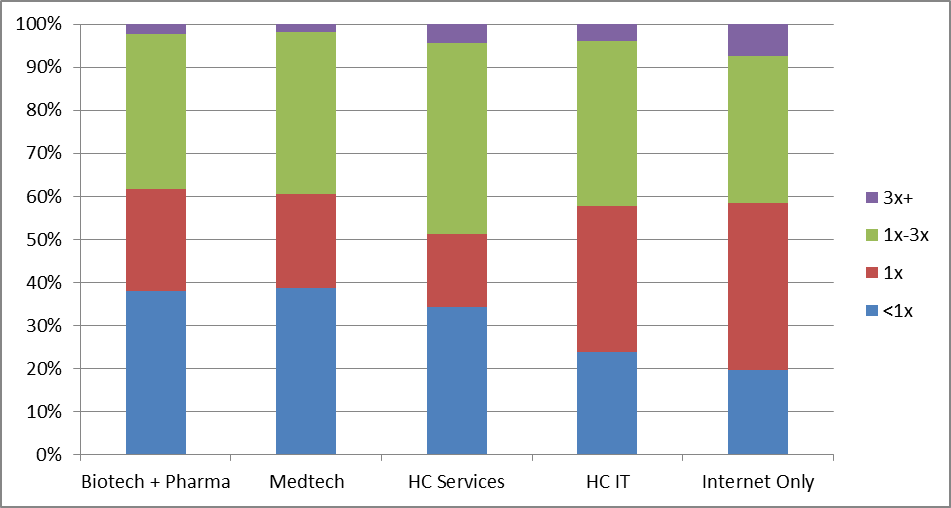
Compare that to the internet sub-sector of IT – which is the sub-sector that LPs and industry watchers mostly focus on. For internet companies, only 20% of all investment rounds are being carried at less than 1x and a whopping 7% are being carried at 3x+ their original cost.

This disparity between sectors at the two ends of the returns curve is notable. We explored the reasons behind it in the article last summer – and capital efficiency clearly has alot to do with it. It’s harder to have marked up rounds when so much capital has to go into healthcare companies vs. tech companies.
But there is more to it: interim milestones in healthcare companies just aren’t valued as much by outside firms as revenue or momentum growth is in tech and internet companies.
Making this worse is that as the healthcare venture ecosystem shrinks, there are less and less firms that are even able to lead follow-on rounds for companies – and reduced competition is a bad thing for both entrepreneurs and early stage investors alike who are left holding the bag or taking an “any-pre” round to get a company financed.
So, following Bruce’s lead, here is my glass half-full prediction for healthcare venture for the next decade:
Realized gross IRRs in healthcare will continue to be strong and consistent – as they have been for the past 3 decades. Probably in the 15%-20% range – perhaps even somewhat higher if an IPO market ever returns for venture-backed healthcare companies.
LPs will continue to make money investing in funds with healthcare exposure. Pharma, medtech, and health insurers – all sitting on growing and massive mountains of cash – must keep buying new companies to help their flat organic growth rates.
Now here is my glass-half empty prediction:
The unrealized problem will only grow worse. There will be more ugly down rounds in healthcare. The unrealized IRR will go down further and the number of companies valued <1x will continue to increase.
“Vulture venture” investing will proliferate in healthcare. And it will be the longest buyer’s market we have seen in any sector of venture capital since the creation of the asset class. What we will have is a “name your price” market for many companies in many sub-sectors of healthcare for the next several years.
These flat and down rounds will exacerbate the patently incorrect perception in some circles that healthcare venture is in some way “damaged” – and it will particularly be so in diversified firms where internet partners will be the heroes for the next couple of years as the public markets absorb the high flying consumer internet companies of the past few years at huge gains to the small handful of VCs who invested in those companies.
Of course, there were some excesses in the 2006-2007 vintages in healthcare – too many early stage medtech and biopharma companies were likely funded in those two years – which probably explains why 2007 is only 1 of 2 vintage years since 1981 where investments in healthcare venture companies have a negative realized gross IRR.
But it’s important for everyone to focus on realized returns as the only barometer of the true health of a sector. While unrealized is interesting data – it probably over-estimates IT and Internet returns and under-estimates healthcare returns.
The NVCA and Cambridge Associates actually do LPs and the entire venture industry a dis-service by publishing aggregate realized+unrealized data when they put out their quarterly company level returns data by sector and not breaking out realized returns from unrealized data.
Headed into the 30th Annual JP Morgan Healthcare Conference – my 10th one in attendance, I am very hopeful about the future of healthcare venture.
Those with money and investment fortitude over the next few vintages will see continue to see some exceedingly strong realized returns.


You must be logged in to post a comment.